The battery is often considered the energy heart of an electric bike. Without it, even the most powerful motor becomes unusable. However, when a user wishes to replace their battery, many questions arise : are there several types of batteries for electric bikes? Can one install a battery from a different brand? Is it possible to increase the range with a more powerful battery? Why do some batteries cost more than €1,000 while others are available for a few hundred euros?
These questions are legitimate as the electric bike market has become particularly complex. Between proprietary batteries developed by major manufacturers and more universal solutions offered by retrofit or conversion specialists (Bafang, Tongsheng...), it is not always easy to navigate. However, understanding the differences between existing technologies is essential to extend the lifespan of one's electric bike, optimise its range and avoid sometimes costly mistakes.
The different battery technologies for electric bikes
Today, almost all electric bikes sold in Europe use batteries lithium-ion. This technology has gradually established itself thanks to its high energy density, relatively low weight, and longer lifespan compared to older generations of batteries.
Before the arrival of lithium-ion, some electric bikes were equipped with lead-acid batteries or nickel-metal hydride (NiMH) batteries. These technologies have virtually disappeared from the market due to their significant weight, low range, and limited lifespan.
The lithium-ion has now become the industry standard. However, behind this name lie several types of cells produced by different manufacturers such as Samsung, LG, Panasonic, Sony, and EVE. These cells are then assembled by battery manufacturers to create packs tailored to the needs of electric bikes.
This is, by the way, a point often overlooked: Bosch, Shimano, Yamaha, or Brose generally do not manufacture the cells of their batteries themselves. They rather develop the management electronics, safety systems, and communication interfaces that allow the battery to work with their ecosystem.
The different battery formats available on the market
Beyond the technology used, batteries are also distinguished by their location on the bike.
The rack batteries have long dominated the urban bike market. Installed at the rear of the bike, they offer simple integration but shift the centre of gravity towards the back. They can still be found on many entry-level or mid-range urban models.
The frame-integrated batteries have gradually become established on modern electric bikes. They offer a cleaner design, better weight distribution, and improved protection against the elements. Bikes like those from Moustache, Cube, or Trek widely use this architecture.
High-end cargo bikes go even further with dual battery systems. This configuration can be found on certain models from Riese & Müller, Tern, or Urban Arrow to exceed 1,000 Wh of autonomy.
The Hailong battery: the standard for conversion kits
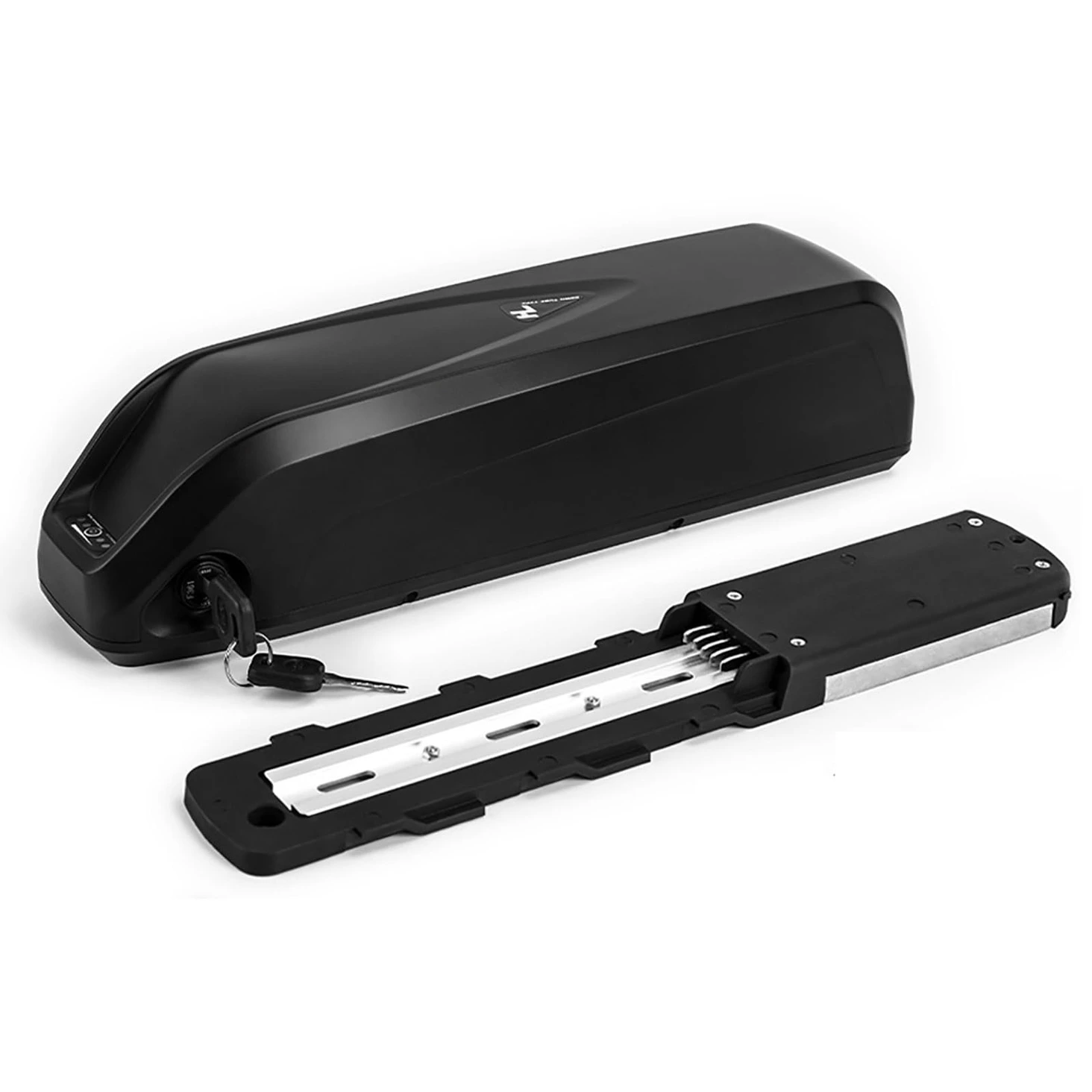
The so-called Hailong is probably the most widespread in the world of Bafang, Tongsheng, Virvolt, Ozo kits and many artisanal conversions.
The term Hailong does not refer to a battery technology but a type of casing.
This format is generally fixed to the frame's bottle holder inserts and integrates:
- lithium cells,
- the BMS,
- the mounting rail,
- the locking system.
Hailong batteries can be found at:
- Green Cell,
- Unit Pack Power (UPP),
- Yose Power,
- Ozo,
- Virvolt,
- EEL Battery,
- and many assemblers.
Their success comes from their ease of assembly, relatively low cost, and excellent compatibility with Bafang BBS01, BBS02, BBSHD, or Tongsheng TSDZ2 motors.
Bottle Batteries
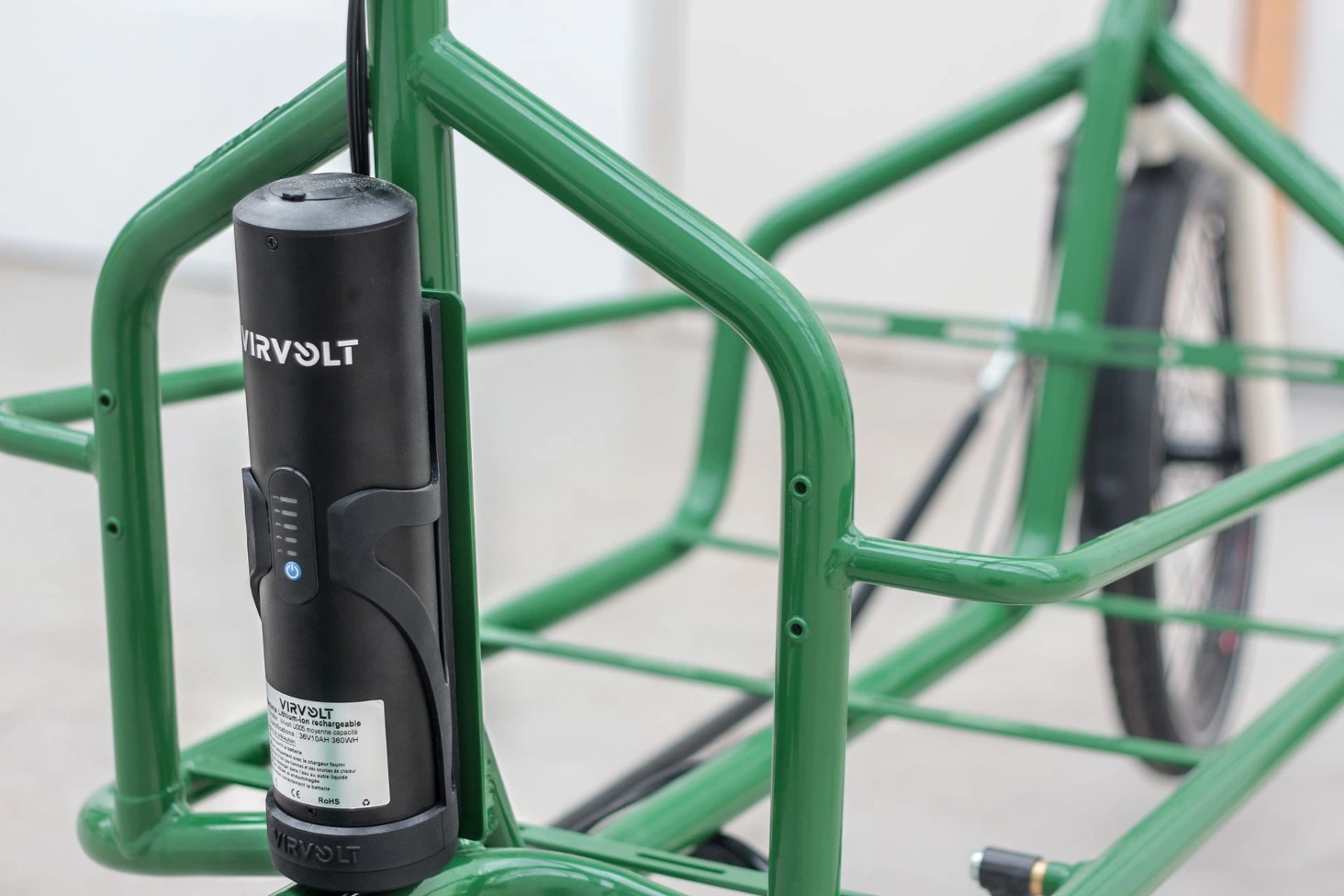
Gourde batteries, sometimes called "Bottle Battery", were among the first widely distributed conversion batteries.
Their shape resembles that of a classic bike water bottle.
Today they are less common but remain interesting for :
- road bikes,
- folding bikes,
- some lightweight hybrid bikes.
Their capacity is often more limited than that of modern Hailong batteries.
They can still be found on certain kits :
- Bafang,
- Tongsheng,
- Yose Power,
- Swytch.
The Polly, Polly DP and Reention batteries
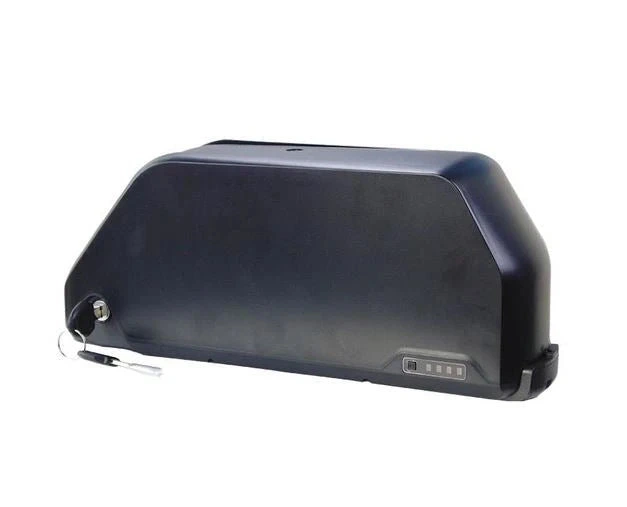
In the retrofit world, the formats Polly have become extremely popular.
Polly cases are manufactured notably by :
- Reention,
- Phylion,
- Dorado,
- HL.
We often talk about :
- Polly
- Polly DP
- Dorado
- Reention Dorado
These batteries have gradually replaced some Hailong batteries on high-end bikes because they offer :
- better aesthetic integration,
- better rigidity,
- significant capacities,
- better waterproofing.
They now equip many production electric bikes.
The Dorado batteries
The format Dorado has become a standard among many European manufacturers.
It is notably used by :
- Virvolt,
- Ozo,
- Mahle on certain systems,
- several Asian OEM manufacturers.
Its main advantage lies in its semi-recessed integration into the diagonal tube.
The rendering is much closer to modern Bosch or Shimano bikes.
Rack batteries (rear rack)

Rear rack batteries remain very present on :
- city bikes,
- Dutch bikes,
- some entry-level cargo bikes.
They are particularly appreciated when the frame does not allow for the integration of a battery in the main triangle.
Brands like :
- Phylion,
- Green Cell,
- E-bike Vision,
- TranzX
still offer many references in this format.
Integrated batteries
This is now the dominant format on recent electric bikes.
It can be found in :
- Bosch PowerTube,
- Shimano Steps,
- Yamaha Integrated Battery,
- Brose,
- Fazua,
- Valeo.
These batteries offer :
- a better design,
- better protection,
- a lower centre of gravity.
In return, they are often more specific to each manufacturer.
Why are formats important for compatibility?
Many cyclists think that a battery is compatible as long as it shows the correct voltage.
In reality, it is necessary to check:
- the voltage (36V, 48V, 52V),
- the maximum deliverable current,
- the BMS,
- the connector,
- the physical format.
This is why a Hailong Green Cell 48V battery can work perfectly with a Bafang BBS02 while it will be completely incompatible with a Bosch Performance Line motor, which is also powered by 36V.
The most commonly used bike battery formats today
If we look at the European retrofit and motor kit market, the most widespread formats are:
- Hailong
- Dorado
- Polly / Polly DP
- Bottle
- Rack
- Custom batteries for cargo bikes
- Proprietary integrated batteries from Bosch, Shimano, Yamaha, Brose, and Valeo
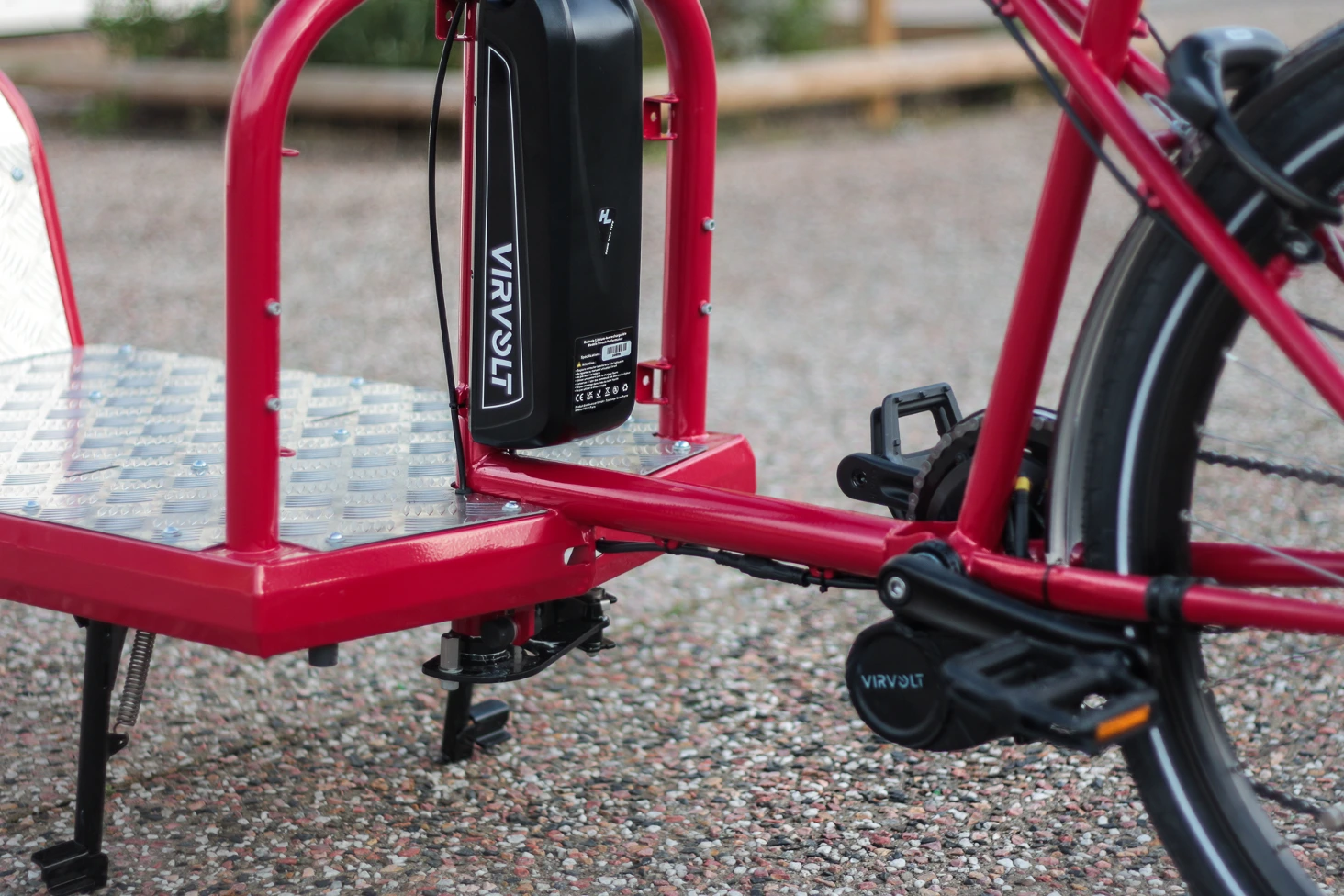
Understanding the actual power of a battery: volts, ampere-hours, and watt-hours
Many users still confuse capacity and power when they talk about an electric bike battery.
The voltage, expressed in volts (V), determines the electrical level of the system. Modern electric bikes generally operate at 36 V or 48 V.
The capacity, expressed in ampere-hours (Ah), indicates the amount of energy that the battery can store.
The most relevant data remains the watt-hour (Wh), which corresponds to the total amount of energy available.
A Bosch PowerPack 500 battery, for example, offers around 500 Wh of capacity, while a Bosch PowerTube 750 reaches 750 Wh. The latter will therefore allow for a greater distance to be covered under comparable conditions.
How to calculate the amount of energy WH?
Calculating Watt-hours (Wh) from Ampere-hours (Ah) is very simple:
Wh=V×Ah
where:
V = battery voltage (Volts)
Ah = battery capacity (Ampere-hours)
Wh = stored energy (Watt-hours)
Example 1: Battery 36V - 10 Ah
36×10=360Wh
This battery contains approximately 360 Wh of energy.
The major battery brands present in the market
The electric bike market is dominated by several large manufacturers of complete systems.
Bosch is currently the European leader with its PowerPack and PowerTube batteries used on hundreds of electric bike models.
Shimano offers its own Steps batteries compatible with the EP8 motors, EP6 or E6100.
Yamaha notably equips many Giant and Haibike bikes.
Brose is used on several Specialized, Rotwild and Douze bikes.
There are also systems developed by Bafang, Tongsheng, Ananda, Mahle, Fazua and Valeo.
Each manufacturer generally develops its own electronic communication system between the battery and the motor.
Can a Bosch battery be replaced by a Shimano battery?
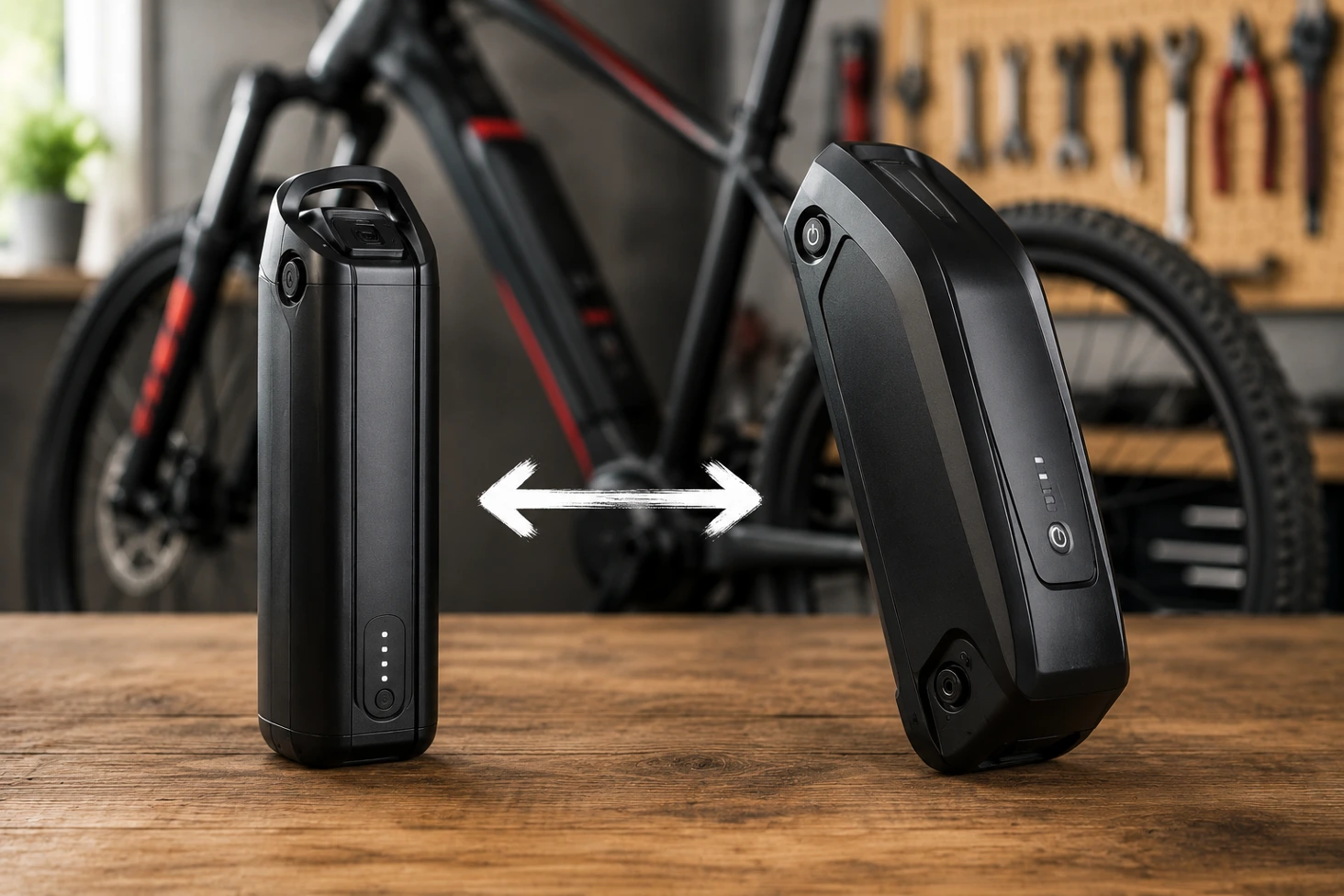
This is probably one of the most frequently asked questions in the world of electric bicycles.
The answer is generally no.
A Bosch system is designed to work with a Bosch battery. The motor, the controller, the display, and the battery constantly communicate through proprietary electronic protocols. A Shimano battery will not be able to communicate properly with a Bosch motor.
The same logic applies to Yamaha, Brose, Fazua, or Valeo. Each manufacturer develops its own ecosystem to ensure the safety, performance, and control of its maintenance network.
This incompatibility is not only about physical connectors. Even when a battery has the same voltage, the embedded software often prevents its use with a competing system.
When can one really choose the brand of their battery?
"A Bosch battery generally cannot replace a Shimano battery" referred to the complete proprietary systems (Bosch, Shimano Steps, Yamaha PW, Brose, Valeo, Fazua, Mahle, etc.).
In contrast, more "open" motors such as:
- Bafang (BBS01, BBS02, BBSHD, M420, M510, M620...)
- Tongsheng (TSDZ2, TSDZ8)
- Dapu
- Ananda (on some models)
- MXUS
- Shengyi
- AKM
- some Nine Continent wheel motors
are often much more flexible regarding battery choice.
Why?
These systems generally operate with:
- a given voltage (36V, 48V or sometimes 52V),
- a compatible controller,
- a suitable connector,
- and an appropriate BMS (Battery Management System).
The motor does not necessarily "communicate" with the battery via a complex proprietary protocol like Bosch or Shimano.
For example, a Bafang BBS02 48V motor can work with:
- a Green Cell battery,
- an Ozo battery,
- an EEL battery,
- a UPP (Unit Pack Power) battery,
- a custom-made battery,
- a refurbished battery.
Provided that:
- the voltage is compatible,
- the maximum current can be delivered,
- the connector is suitable.
Concrete example
Let's take a Bafang BBSHD.
The motor can be paired with:
- a 48V 14 Ah (672 Wh) battery,
- a 48V 17.5 Ah (840 Wh) battery,
- a 48V 20 Ah (960 Wh) battery,
- or even a 52V battery in some configurations.
The motor does not "see" the brand of the battery.
It primarily "sees":
- the voltage,
- the available current,
- the electronic safety features.
It is very different from a Bosch Smart System where the battery, motor, display and controller exchange encrypted information.
Green Cell is a good example of a battery manufacturer for bikes.
This brand offers :
- universal 36V batteries,
- universal 48V batteries,
- batteries for conversion kits,
- batteries compatible with many open motors.
They are regularly used with :
- Bafang,
- Tongsheng,
- MXUS,
- Shengyi,
- Dapu,
- Ozo kits,
- Virvolt kits.
But they are generally not compatible with an original Bosch or Shimano system.
Be careful with the notion of compatibility
When talking about battery compatibility, three levels must be distinguished :
- Electrical compatibility
The voltage must be the same :
- motor 36V → battery 36V
- motor 48V → battery 48V
2) Power compatibility
The BMS and cells must be able to provide enough amps.
For example :
- a Bafang BBSHD can demand more than 25 A,
- some small urban batteries can only provide 15 A.
Even if the voltage is correct, this can cause :
- cuts,
- overheating,
- a safety shutdown.
3) Physical compatibility
The connector must be compatible :
- Anderson,
- XT60,
- XT90,
- Hailong,
- Rosenberger,
- proprietary connectors, etc.
Can you increase the capacity of your battery?
The situation is different when you want to increase the range while staying within the same ecosystem.
A user equipped with a Bosch PowerPack 400 battery can generally switch to a compatible PowerPack 500. Similarly, some Shimano ranges allow you to replace an old battery with a newer version offering more capacity.
However, it is necessary to check several parameters : the mechanical compatibility, the system voltage, any software updates and the manufacturer's recommendations.
When these conditions are met, increasing the capacity of your battery often allows you to gain several dozen kilometres of range without altering the behaviour of the bike.
What to do when a battery is no longer available?
This is currently one of the main challenges in the electric bike market.
Many users still own bikes that are perfectly functional mechanically but have become unusable because their battery is no longer produced.
This situation particularly affects certain older systems Impulse, Panasonic, Yamaha or Shimano whose oldest references are sometimes difficult to find.
In this context, several solutions exist. The refurbishment involves replacing the internal cells while retaining the original casing and electronics. Specialist companies manage to give a second life to many batteries.
Another approach is to modernise the entire electrical system of the bike.
Can the battery and motor system be completely replaced?
The answer is yes, but this generally requires more than just a simple battery replacement.
When a proprietary system becomes irreparable or obsolete, some users choose to install a new motorisation accompanied by a new battery. This solution is particularly interesting when the bike frame is still in excellent condition.
Open motors like those from Bafang or Tongsheng often offer more flexibility in battery choice.
Solutions like those offered by Save My eBike allow for the adaptation of certain old proprietary motorisations to more standard and repairable systems. This approach significantly contributes to extending the lifespan of many electric bikes that would otherwise have ended up as waste.
From that moment on, the owner generally finds much more freedom to :
- choose their battery,
- increase their range,
- have your pack refurbished,
- or replace your battery with a model from another brand.
This is a major difference between proprietary ecosystems (Bosch, Shimano, Yamaha...) and open systems (Bafang, Tongsheng, Dapu, etc.).
The battery has become a major sustainability issue
As the fleet of electric bikes ages, the battery issue becomes central. A battery often represents between 20% and 40% of the total value of the bike. Its replacement directly affects the lifespan of the entire system.
The market is gradually evolving towards more repairability, refurbishment and compatibility. Consumers are increasingly attentive to the availability of parts and the possibility to extend the life of their equipment.
In the coming years, the ability to replace or refurbish a battery will likely be as important as the range or power displayed at the time of purchase.
Conclusion
The market for batteries for electric bikes is currently dominated by lithium-ion technologies and increasingly sophisticated systems developed by Bosch, Shimano, Yamaha, Brose, Valeo, Mahle, Fazua, Bafang or Tongsheng. While batteries can sometimes be replaced with higher capacity models within the same brand, exchanges between manufacturers remain generally impossible due to proprietary electronic systems.
When a battery becomes untraceable or an entire system reaches the end of its life, the refurbishment or the complete replacement of the motorisation often constitutes the best solutions. Thanks to new technologies and specialised adapters, it is now possible to extend the lifespan of an electric bike well beyond what was conceivable just a few years ago.