When an electric bike breaks down permanently, the question may arise: where to dispose of an electric bike? Can it be taken to a waste disposal site? What to do with the battery? Should the motor be dismantled? Are there associations that collect electric bikes? And above all, is it really necessary to throw away an e-bike simply because its motor or its battery no longer works?
The answer deserves to be nuanced. An electric bike is both a traditional bike and an electrical device consisting notably of a motor, a lithium-ion battery, a controller, a display and various cables and sensors. Its end of life should therefore be managed differently from that of a conventional bike.
In many European countries, the electric bike and its battery must be directed towards collection channels suitable for electrical equipment and batteries. But before talking about recycling, another solution should systematically be considered: repair, refurbishment, donation or even replacement of the motorisation. It is particularly in this last category that the retrofit solutions offered by Save My eBike can help save certain electric bikes whose original motor has become irreparable or unavailable.
Can an electric bike be thrown in the bin?
No. An electric bike that is out of service should not be discarded with regular household waste.
The reason is both environmental and safety-related. The motor contains electrical and electronic components, while the battery can hold several hundred watt-hours of energy in the form of lithium-ion cells. A damaged, crushed, or short-circuited battery can pose a fire risk during transport or in sorting centres.
The US Environmental Protection Agency, the EPA, reminds us that lithium-ion batteries and devices containing them should not be placed in household rubbish or ordinary recycling bins, as they can cause fires.
In the UK, the government also states that electrical equipment and batteries should be directed to appropriate collection points and must not be thrown away with household waste.
The practical rule is therefore simple: a broken electric bike is an electrical waste when it is no longer repairable, and its battery requires special attention.
Before discarding your electric bike, check if it can still be saved
This is probably the most important advice in this article.
An electric bike that no longer works is not necessarily a bike to be 'thrown away'.. A failure of assistance can come from the battery, the charger, a sensor, a cable, a connector, the controller, or the electronics, and not necessarily from the motor.
Even when the motor is truly out of service, several scenarios can be considered. A Bosch, Shimano, Brose, Yamaha or Bafang motor can sometimes be repaired or replaced. On some systems, there are refurbished motors or parts that can extend the lifespan of the bike.
This logic is indeed consistent with the recommendations of the recycling sectors themselves. In France, ecosystem encourages consumers to consider repair before parting with an electrical device and offers a tool to find a repairer or a collection solution.
The question to ask is therefore not immediately "where to throw away my electric bike?", but rather:
"Is this really the end of life for the bike, or just the end of life for its motor or battery?"
This distinction can save several hundred, or even several thousand euros for a cargo bike, a high-end e-MTB or a professional e-bike.
What to do with the battery of an electric bike at the end of its life?
The battery is the part that requires the most precautions.
A lithium-ion battery from an electric bike should never be thrown in a regular bin. It must be taken to a specialised facility capable of collecting, storing and recycling it under appropriate conditions.
In France, ecosystem specifies that all types of electric bike batteries can be dropped off at appropriate collection points, including bike retailers and certain recycling centres. The organisation particularly recommends protecting the terminals with adhesive tape before handing over the battery.
If the battery is swollen, deformed, punctured, hot, leaking or shows signs of damage, do not attempt to open or repair it yourself. It should be reported to the collection point so that staff can apply an appropriate procedure.
This precaution is particularly important with lithium-ion batteries. In Switzerland, INOBAT indicates, for example, that damaged or deformed batteries should be returned to a collection point with staff and reminds of the fire risk associated with improperly disposed lithium-ion batteries.
Why is the battery of my electric bike no longer working?
To readWhere to dispose of your electric bike in France?
In France, the simplest solution is to use the collection network ecosystem and to look for a point that accepts electrical devices, mobility batteries or electric bikes.
Find an ecosystem collection point
For an electric bike battery, ecosystem indicates that it can be returned to a bike retailer or an appropriate collection point, including at a recycling centre.
For the complete bike, it is advisable to ask the recycling centre or collection point if e-bikes are accepted as they are and whether the battery needs to be removed beforehand. Practical rules may vary by local authorities.
Another interesting avenue in France is that of solidarity reuse. Emmaüs indicates that it accepts bicycles among the items that can be donated.
In Lyon, for example, The Workshops of Audacity, integrated into the Emmaüs Movement in 2026, specialise in the repair and resale of bicycles and have already refurbished over 1,600 bicycles. Their address provided by Emmaüs France is 45 rue de la Part-Dieu, Lyon 3rd. However, for an e-bike, it is essential to contact them beforehand to verify that they accept the specific electric model and its battery.
Emmaüs France – donate an item or find a structure
Germany: where to drop off an electric bike or a battery?
Germany has a particularly structured system for the take-back of electrical waste.
The stiftung ear explains that batteries from light means of transport, particularly electric bike batteries, can be returned to appropriate collection and take-back points. Retailers and certain recycling centres are involved in these arrangements.
For electrical devices that are no longer in use, Germany also uses a mapping search system for take-back points. The stiftung ear indicates that the E-Waste Return Finder allows you to find take-back points at recycling centres, distributors, and certain shops.
stiftung ear – official information on the take-back of electrical waste
Before transporting an electric bike battery, it is necessary to check that the selected point accepts light mobility batteries and, above all, that it is equipped to handle a potentially damaged battery.
United Kingdom: Recycling Centre and take-back by shops
In the United Kingdom, a non-functional electric bike falls under the logic of Waste Electrical and Electronic Equipment, or WEEE.
The British government states that electrical equipment can be dropped off at Household Waste Recycling Centres, which are local household waste recycling centres. When purchasing new electrical equipment, an equivalent take-back may also be offered as part of the obligations applicable to distributors.
The site Recycle Now has a search tool that allows you to enter your postcode to find the nearest recycling centre that accepts electrical equipment.
Recycle Now – find a recycling centre in the United Kingdom
However, it is important to distinguish the complete bike from its battery. A high-capacity lithium-ion battery may require a specific process. Therefore, before you go, it is better to specify that it is an e-bike battery.
Denmark: the electric bike goes to the genbrugsstation
In Denmark, local authorities have genbrugsstationer, the municipal recycling centres.
The municipality of Copenhagen explicitly states that an elcykel, that is to say an electric bike, must be sorted as “large electronic equipment”. A functional electric bike can also be directed towards reuse at recycling stations.
For the battery, the instructions are even more precise: electric bike and scooter batteries must be dropped off at a recycling station or with a seller who takes them back.
In Copenhagen, several addresses exist, including Borgervænget Recycling Station, Sibeliusgade 80, 2100 Copenhagen Ø, Bispeengen Recycling Station, Bispeengen 35, 2000 Frederiksberg, or Vermlandsgade Recycling Station, Herjedalsgade 2, 2300 Copenhagen S.
In other Danish regions, one must use the local authority's network of recycling sites. AffaldPlus, for example, publishes the addresses of its various recycling stations.
Spain: the “puntos limpios” for electrical waste
In Spain, waste from electrical and electronic equipment is governed by the WEEE regulations.
The Spanish Ministry of Ecological Transition specifies that individuals can drop off their electrical waste for free at local authority collection facilities, including fixed or mobile puntos limpios, as well as in certain authorised collection systems.
The Spanish framework is particularly interesting for electric bikes: the ministry specifies that unapproved two-wheeled electric vehicles, including unapproved electric bikes, fall within the scope of waste from electrical and electronic equipment.
MITECO – official information on WEEE in Spain
In practice, therefore, look for the Punto Limpio in your municipality or autonomous community and ask if the complete electric bike is accepted. If the battery is removable, also ask if it needs to be disposed of separately.
Italy: Collection Centre and WEEE system
In Italy, the system revolves around WEEE, the Waste Electrical and Electronic Equipment.
The WEEE Coordination Centre coordinates the collection and management of electrical waste across Italy. Municipal collection centres are one of the main entry points for individuals. The system also provides for take-back mechanisms by distributors, particularly when purchasing equivalent equipment.
WEEE Coordination Centre – Italian collection system
Italian municipalities can also publish their own access and sorting rules. A concrete example is the Collection Centre of the Municipality of Como, located Via Stazzi, which accepts different categories of waste and also has a space dedicated to reuse.
Again, it is necessary to check with the centre that the electric bike and its battery correspond to the streams it accepts.
Belgium: Recyparc, Recupel and Bebat
Belgium has two particularly important players when it comes to distinguishing electrical equipment from its battery: Recupel for electrical appliances and Bebat for batteries and accumulators.
For an electric bike, Bebat clearly states that the batteries from bikes and electric scooters can be dropped off at recycling parks and bike shops. Damaged batteries, those that are leaking or exposed must be dropped off at a recycling park equipped to handle them.
Bebat has over 23,000 collection points in Belgium and offers a map to search for a point by street, municipality or postcode.
Bebat – find a collection point
For electrical equipment, Recupel also has a network of collection points. The organisation recommends dropping off electrical appliances that are no longer repairable at a Recupel point so that the components can be dismantled and treated properly.
Recupel – find a collection point
In Brussels, Pro Velo also represents an interesting avenue for reuse. The association collects unused bikes and refurbishes them in its workshop. However, it specifies that it mainly accepts mechanically working bikes; for a non-functioning e-bike, it is essential to contact them before making a donation. Its headquarters is located 15 Rue de Londres, 1050 Ixelles.
Switzerland: SENS eRecycling and INOBAT
Switzerland has a particularly developed system for battery recycling.
INOBAT indicates that there are more than 11,000 collection points for batteries and accumulators in the country and that batteries can be returned free of charge at sales or collection points.
For an electric bike battery, INOBAT specifies that it can notably be returned to an electric bike seller or at certain municipal collection centres.
INOBAT – find a collection point in Switzerland
For electrical equipment, SENS eRecycling is also an important national channel. SENS notably offers a system for collecting used electrical equipment and has a nationwide take-back network.
One must be particularly vigilant with a damaged battery: INOBAT specifies that damaged or deformed batteries must be deposited at a collection point with staff.
Austria: Collection point and problem waste collection
In Austria, lithium-ion batteries must not be thrown away with residual waste. DIE UMWELTBERATUNG recommends depositing them in a problem waste collection (problem waste collection) and provides a link to the national map of collection points Elektro-ADE.
Elektro-ADE – search for a collection point in Austria
The Elektro-ADE network lists collection points across the country and allows searches by postal code or municipality.
In the case of a swollen, damaged, or behaving abnormally battery, caution should be increased: the Austrian organisation recommends professional handling rather than prolonged storage at home.
United States: where to recycle an electric bike battery?
In the United States, the situation is different as the rules can vary by state. For electric bike batteries, a particularly interesting national scheme now exists with The Battery Network.
The former Call2Recycle programme changed its name in January 2026 to become The Battery Network. The organisation now offers a specific programme dedicated to electric bike batteries, developed with manufacturers and stakeholders in the cycling industry.
The Battery Network – recycling electric bike batteries
The network has a tool to search for a collection point nearby. However, it is necessary to check that the battery brand is part of the programme, as not all e-bike batteries are currently accepted by all participating points.
The Battery Network – find a drop-off point
For a damaged or defective battery, it should not be placed in a standard collection box. The Battery Network has specific procedures for these batteries.
Donating your electric bike to a charity: an alternative to recycling
Recycling is not necessarily the best destination for an electric bike that is still functioning, or that could be repaired at a reasonable cost.
In many countries, charities collect bikes to repair them, resell them at affordable prices, or redistribute them to people in need.
In France, Emmaüs accepts bikes among the items that can be donated.
In Switzerland, Velafrica is a major example of a bicycle reuse sector. The organisation has over 300 collection points and has recovered approximately 45,500 bicycles in 2024. Its activities are particularly based on reuse, the recovery of parts, and the sending of bicycles to partners in Africa.
In Spain, Bicicletas sin Fronteras has also developed a significant activity around the donation and reuse of bicycles. However, the association explains that it has changed its strategy after noticing that some second-hand bicycles sent from Europe quickly broke down and ultimately became a problem for the beneficiaries. This example is particularly instructive: giving a bicycle in poor condition is not always an ecological or supportive gesture.
In the United States, Bikes Not Bombs, in Boston, collects thousands of bicycles each year to refurbish them and support its local and international programmes. Its workshop is located at 284 Amory Street, Jamaica Plain, MA 02130. However, be aware: the association explicitly states that it does not accept electric bicycles in its donation programme.
This example shows why it is always necessary to contact an association before dropping off an e-bike: an organisation that accepts traditional bicycles may refuse electric bicycles due to their battery, electronics, or the cost of refurbishing them.
What to do with an electric bicycle whose motor is broken but whose frame is still good?
This is probably the most interesting question when discussing the end of life of an e-bike.
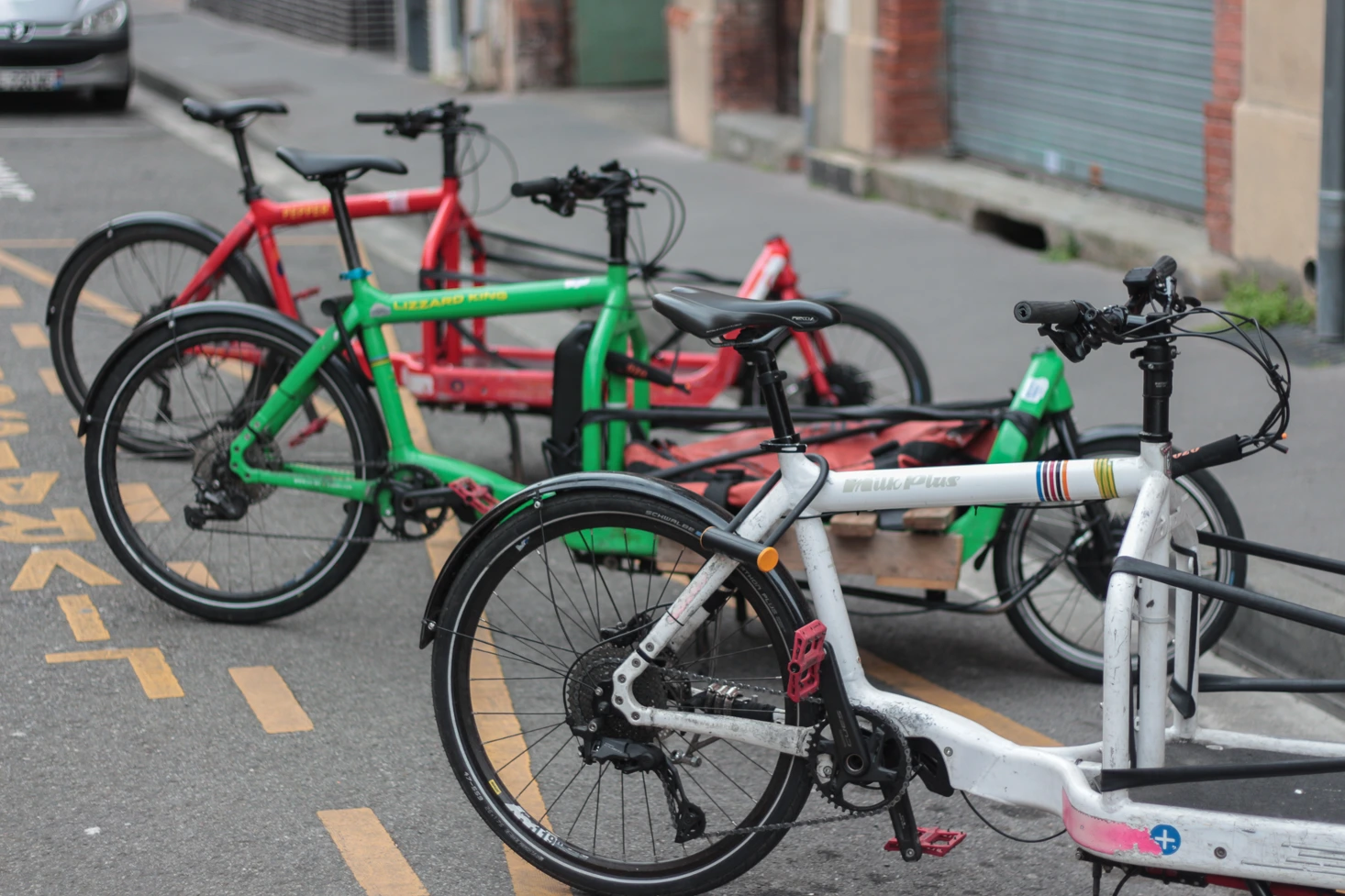
Imagine a Bullitt whose Shimano EP8 motor no longer works. The frame is still excellent, the wheels are in good condition, the brakes work, the cargo box is intact, and the bike still represents a real value in use.
Throwing it away entirely for a motor issue may seem disproportionate.
The same reasoning applies to a Douze G4 equipped with a Brose motor, an e-bike equipped with an old Shimano Steps, a bike equipped with a Yamaha or Impulse motor, or even some electric bikes whose proprietary motorisation is no longer easily available.
In this case, one must consider a fourth option between replacing the bike and recycling it: retrofit, that is to say, transforming the existing bike to give it a new motorisation.
Save My eBike: a final solution to save a broken electric bike
It is precisely on this issue that Save My eBike.
positions itself. The principle is not to consider the original motor as a part that automatically condemns the frame when it reaches the end of its life. The adapters developed by Save My eBike allow, in certain configurations, to replace the mechanical footprint left by an old central motor and revert to a configuration compatible with a bottom bracket.
The bike can then be kept as is mechanically, or be re-electrified with a new solution suited to the frame.
Save My eBike – save your electric bike with an adapter
Save my eBike offers adapters for certain motors Shimano, Brose, Yamaha and Impulse. Depending on the model of adapter and the bike in question, it then becomes possible to install an alternative motor, particularly certain crank motors Bafang, Tongsheng or Virvolt, or to consider a wheel motor.
A particularly concrete example concerns Les Cargos toulousains which used these adapters to save a fleet of Bullitt bikes equipped with Shimano EP8 and E6100 motors out of warranty, before re-electrifying them with front wheel motors. Save My eBike also documents the case of a Douze G4 equipped with a Brose motor brought back into circulation thanks to an adapter.
There are even adapters dedicated to certain generations of Shimano. The adapter announced for the Shimano EP8, E8000 and E6100, for example, has a threaded bottom bracket of 68 mm and is said to be compatible with certain crank motors from Tongsheng, Bafang and Virvolt.
The interest of this approach is therefore to shift the reasoning. Instead of desperately searching "where to find exactly the same motor?", one can sometimes ask:
"How to keep this bike and only replace the technology that has become obsolete?"
Recycle or save your electric bike: how to make the right decision?
The decision ultimately depends on the overall condition of the bike.
If the frame is cracked, heavily corroded or damaged, the wheels are unusable, the transmission is worn, and the battery is also at the end of its life, recycling may be the most rational solution.
Conversely, if the frame is sound and only the motor or battery is problematic, a repair or refurbishment is worth considering.
For a professional cargo bike, the question is even more important. A cargo bike like a Bullitt, a Douze G4, a Tern GSD, or another model intended for delivery can represent a significant investment. Disposing of the entire bike because a single part of the motorisation is out of service can lead to considerable economic and material waste.
In some cases, a new battery is sufficient. In others, the motor can be repaired. In yet others, the proprietary system can be replaced with a different architecture.
Recycling should therefore be the last step, not necessarily the first.
Where to dispose of your broken electric bike: reference points by country
| Country | Electric bike out of service | E-bike battery | Address / useful tool |
|---|---|---|---|
| 🇫🇷 France | Recycling centre / WEEE stream | ecosystem, bike retailer, suitable recycling centre | ecosystem – find a collection point |
| 🇩🇪 Germany | Recycling yard / WEEE point | Retailer, suitable collection point | stiftung ear – take-back of electrical waste |
| 🇬🇧 United Kingdom | Household Waste Recycling Centre | Specialist point / retailer | Recycle Now – localisation |
| 🇩🇰 Denmark | Recycling station | Recycling station or dealer | Copenhagen: Bispeengen 35, 2000 Frederiksberg |
| 🇪🇸 Spain | Clean Point / local collection | Adapted local system | MITECO – WEEE drop-off points |
| 🇮🇹 Italy | WEEE Collection Centre | Collection centre / distributor | WEEE Coordination Centre |
| 🇧🇪 Belgium | Recyparc / Recupel | Bebat / bike dealer | Bebat – find a point |
| 🇨🇭 Switzerland | SENS / municipal collection | INOBAT / bike dealer | INOBAT – collection points |
| 🇦🇹 Austria | Collection point / Elektro-ADE | Hazardous waste collection | Elektro-ADE – collection points |
| 🇺🇸 United States | Local e-waste / municipal facility | The Battery Network for participating brands | The Battery Network – e-bike batteries |
Attention : these networks evolve and acceptance conditions may depend on the municipality, the battery brand, its condition, and whether it can be removed from the bike. It is therefore advisable to check the collection point before transporting an e-bike or battery.
Can you throw away just the electric bike motor?
Yes, but it is better to consider it as a waste electrical and electronic equipment (WEEE), and not as a simple metal part.
A Bosch, Shimano, Brose, Yamaha or Bafang motor contains electronic components, magnets, windings and various mechanical elements. It should therefore be entrusted to a system capable of properly processing electrical waste.
But again, before recycling, it may be worthwhile to look for a workshop capable of repairing or refurbishing the motor.
This is particularly relevant for older Bosch, Shimano Steps, Brose or Yamaha motors, for which independent specialists have developed in several European countries.
And what if the battery still works but the motor is dead?
This is a very interesting case.
A still functional battery can sometimes be reused with a new motorisation, but it is not automatically compatible with any motor..
A Bosch, Shimano, Yamaha or Brose system has its own electronic architecture. Therefore, installing a Bafang or Tongsheng motor does not mean that the Bosch or Shimano battery can be kept as is.
In a retrofit project, it is necessary to study the motor, battery, controller, display, sensors, connectors and the mechanical compatibility of the frame separately.
This is precisely why a transformation carried out by a professional may be preferable to a simple 'like-for-like' motor change.
The best way to dispose of an electric bike: do not throw it away too quickly.
When an e-bike breaks down, it is tempting to consider the entire bicycle as waste. However, its frame, wheels, brakes, transmission, fork, and accessories can still have a long lifespan.
The first step is therefore to carry out a diagnosis. If the fault is repairable, the bike can continue to be used. If it is economically irreparable but still mechanically sound, donating it to a charity or refurbishing it can be considered.
If only the battery is at the end of its life, it can generally be directed towards a specific recycling stream.
If the motor is faulty but the bike still has real usability value, replacing the motor or retrofitting it can be an alternative.
And only when these solutions are no longer relevant, the recycling of the electric bike becomes the logical solution.
FAQ: where to dispose of a broken electric bike?
Where to dispose of an electric bike that no longer works?
A non-functional electric bike should generally be directed to a waste disposal site, a recycling centre, or an electrical waste stream that accepts e-bikes. The procedures vary depending on the country and the local authority. In France, ecosystem allows you to search for suitable collection points.
Can you throw an e-bike battery in the bin?
No. An electric bike lithium-ion battery should not be thrown away with household waste. It must be deposited in a specialised collection stream.
Where to dispose of a Bosch, Shimano, or Yamaha battery?
The brand is not enough to determine the collection point. One must look for a point that accepts electric mobility batteries or electric bike batteries. In France, ecosystem indicates it accepts different types of electric bike batteries at designated points.
Can you donate an electric bike to Emmaüs?
Emmaüs accepts bikes and many items in good condition, but the acceptance of an e-bike depends on the local structure and its equipment. It is advisable to contact the community before going.
Does an association necessarily accept a broken electric bike?
No. An association that collects traditional bikes may refuse e-bikes, particularly due to the battery or the cost of diagnosis. Bikes Not Bombs, in Boston, specifies for example that it does not accept e-bikes in its donation programme.
What to do with an electric bike whose motor is irreparable?
One must compare the cost of a new motor, a refurbished motor, and a possible conversion. For certain proprietary motors, an adaptation solution may allow for retaining the frame and replacing the old motorisation with a new architecture. Save My eBike notably offers adapters for certain generations of Shimano, Brose, Yamaha, and Impulse.
Can an old electric bike be saved rather than recycled?
Yes, in certain configurations. A diagnosis may allow for repairing the motor or the battery. When the original motorisation is no longer available or too expensive, a retrofit may sometimes allow for retaining the frame and the mechanical components of the bike. The adapters from Save My eBike are one of the possible solutions for certain frames and certain motorisations.
Conclusion: before throwing away an electric bike, consider repair, donation, refurbishment and retrofit
Where to dispose of my broken electric bike? The answer ultimately depends on the condition of the bike and its country of residence. In France, Germany, Belgium, Switzerland, the United Kingdom, Denmark, Spain, Italy, Austria, as well as in the United States, there are systems in place to collect bikes and especially their batteries.
But the real issue may lie elsewhere. An electric bike with a broken motor is not necessarily a bike at the end of its life.The motor can be repaired, the battery replaced, the bike donated, refurbished or transformed.
This last possibility is particularly interesting for high-end electric bikes and cargo bikes whose frame still has a high value of use. When the proprietary motor from Bosch, Shimano, Brose, Yamaha or Impulse is no longer available or becomes too expensive to replace, a retrofit solution can allow the bike to be kept rather than sent directly for recycling.
This is precisely the goal of the Save My eBike adapters: to offer, when the frame compatibility allows, an additional possibility to save an electric bike whose original motorisation has reached the end of its life.
In other words, before looking for "where to dispose of my broken electric bike", the question that deserves to be asked may be:
"Is it really my bike that is at the end of its life, or just its motor?"
This nuance can transform a bike destined for the dump into bicycle repaired, refurbished, donated or re-electrified for several more years.