The motor is one of the most important components of an electric bike. It is what transforms your pedalling effort into assistance and largely determines the behaviour of the bike : starting power, pedalling feel, torque available on climbs, range and overall enjoyment. When a motor fails, becomes difficult to repair, or when one simply wants to improve the performance of their electric bike, a question often arises: can you install another motor on an electric bike?
The answer is yes… but not always in a straightforward way. Replacing an electric bike motor generally does not just involve removing one part and attaching a new one. An e-bike motor operates within a system composed of a battery, a controller, a display, sensors, a wiring harness, and sometimes a proprietary electronic system. Compatibility between all these elements is therefore essential.
In some cases, a replacement is possible while retaining a large part of the original components. In other situations, the entire electrical system must be modified. There are also today innovative solutions such as adapters that allow for replacing an integrated central motor with a motor from a electrification kit.
Here is everything you need to know before changing the motor of your electric bike.
Is it possible to replace the motor of an electric bike with a motor from another brand?
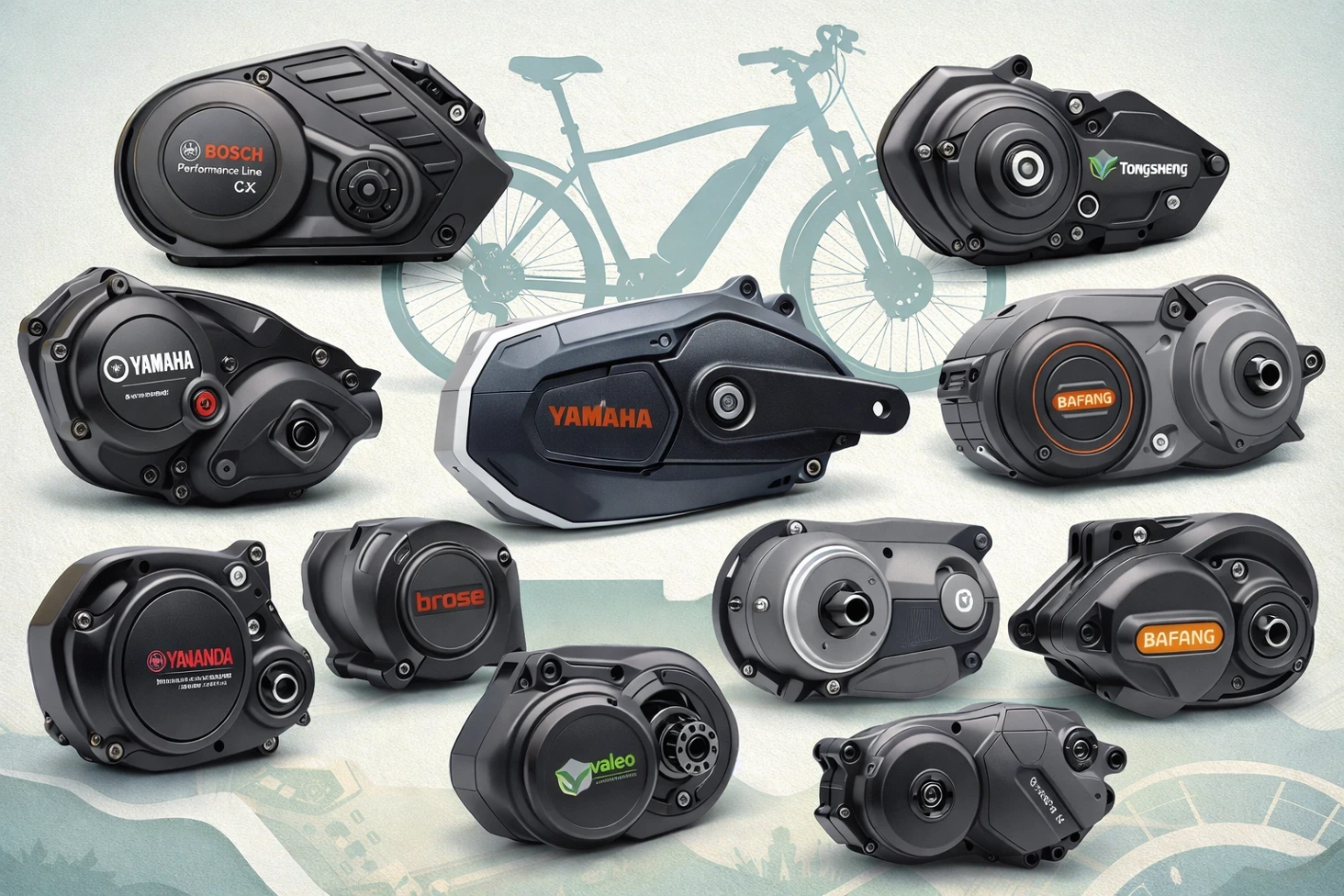
Many owners of electric bikes equipped with a Bosch, Shimano, Yamaha or other brand motor wonder if they can replace their original motor with a model from a different manufacturer.
On paper, this may seem logical: a motor is still a motor, with a mount, power and wiring. In reality, the systems of major brands are often designed as closed sets. A Bosch motor is not simply interchangeable with a Shimano or Yamaha motor, as each manufacturer uses its own electronic protocols, connectors and management software.
For example, a bike equipped with a Bosch Performance Line central motor works with a Bosch battery, a Bosch display, a Bosch controller and specific electronic communication. Installing a Shimano motor in its place would generally require replacing the battery, display and part of the wiring as well.
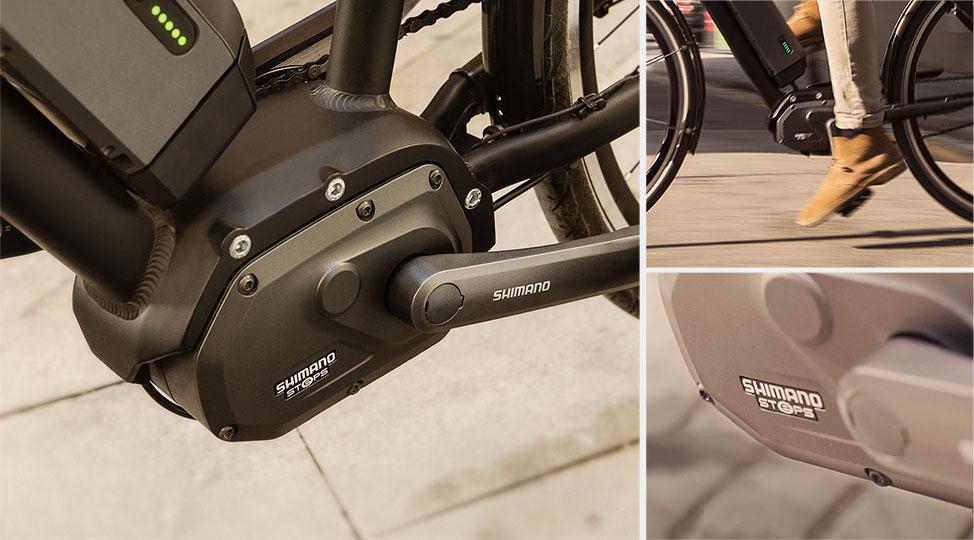
The same logic applies to a bike equipped with a Shimano STEPS or Yamaha PW motor. Even if the motors may have similar characteristics, such as a torque of 60 to 85 Nm, they do not communicate in the same way with other components.
Thus, replacing a Bosch motor with a Shimano EP6, or a Yamaha with a Bosch Gen 4, is technically possible in some conversion projects, but it is generally not a simple standard exchange. This often comes down to converting the bike with a new complete system.
Can a Bosch Gen 2 motor be replaced by a Bosch Gen 4?
Replacing a motor with another model from the same brand is a very common request, particularly among users of electric bikes equipped with older Bosch motors.
A common example concerns Bosch motors from the early generations, such as the Bosch Active Line or Performance Line Gen 2, which some cyclists wish to replace with a newer Bosch Gen 4 motor.
In principle, staying with Bosch seems to be the simplest solution. However, even within the same brand, motor generations are not always interchangeable.
A Bosch Gen 2 and a Bosch Gen 4 do not have exactly the same mechanical architecture, the same mounting points, nor the same electronic connections. The motor, the controller, the internal software, and sometimes the connectors have evolved. A bike designed around a Gen 2 motor will therefore not necessarily accept a Gen 4 motor without modification.
In some cases, the replacement can be done with compatible parts from the same generation. In others, several elements of the system need to be changed: motor, wiring, display, battery, or control unit.
The problem is even more significant when the motor is integrated into a specific frame. Bike manufacturers sometimes design motor housings suited to a specific generation. Even if two Bosch motors appear visually similar, their mountings may be different.
Before replacing a Bosch Gen 2 with a Bosch Gen 4, it is therefore essential to check the mechanical and electronic compatibility.
Can a Shimano E6100 motor be replaced by a Shimano EP6: a possible evolution?
At Shimano, this question often arises with users of STEPS motors. Many wish to replace a Shimano E6100 with a more powerful motor like the Shimano EP6.
The Shimano E6100 mainly equips urban and trekking bikes. It develops about 60 Nm - 80 Nm of torque and prioritises comfort, reliability, and smooth assistance. The newer Shimano EP6 targets more sporty and off-road bikes with a torque of up to about 85 Nm.
On paper, moving from an E6100 to an EP6 seems like an excellent evolution. However, compatibility depends on the bike itself.
The EP6 motor uses a more recent architecture and may require adaptation of the wiring, display, software, or control system. The frame must also accommodate the dimensions and mounting points of the new motor, which apparently is the case most of the time..
In some cases, a Shimano to Shimano replacement is feasible with a suitable set of components. In other cases, the cost of the necessary parts may make the operation less attractive compared to buying a new bike.
However, it is not possible to adapt an e6100 - EP8 motor to a frame designed for a Shimano 6000..
Can you replace only the motor and keep the original battery?
This is probably one of the most frequently asked questions: if my motor is dead, can I simply install a new motor and keep my battery?
The answer mainly depends on the brand and the system used.
With major brands like Bosch, Shimano or Yamaha, the battery is part of a complete ecosystem. It communicates with the motor and the controller. A Bosch PowerTube battery, for example, is designed to work with compatible Bosch motors. It will not be able to directly power a motor from another brand without replacing other components.
In some conversion projects using more open motors, it is easier to keep the existing battery. Some electrification kit motors can work with different batteries as long as the voltage, capacity and current delivered are suitable.
It is also important to consider the condition of the battery. Installing a more powerful motor on an old battery can significantly reduce the range or accelerate its aging.
An electric bike battery is a consumable part. Therefore, before changing only the motor, it is important to check its actual capacity and electrical compatibility.
Replacing a Bafang motor with a Tongsheng motor: a good idea?
Bafang and Tongsheng motors are very popular in the world of electric bike conversions. Unlike the proprietary systems of major brands, they offer more customization options.
A user equipped with a Bafang crank motor may be tempted to switch to a Tongsheng motor, particularly to benefit from a different behaviour.
Bafang motors, such as the BBS01, BBS02 or BBSHD, generally operate with assistance based on the rotation of the crankset and electronic management of the motor. They are known for their power and ease of installation.
Tongsheng motors, particularly the TSDZ2, stand out for their torque sensor that actually measures the pressure applied to the pedals. The riding sensation is often closer to that of a traditional electric bike: the assistance naturally complements the cyclist's effort.
Switching from a Bafang to a Tongsheng is possible, but it is not a direct replacement. The dimensions of the bottom bracket, wiring, battery and accessories need to be checked.
This modification can be interesting for a user seeking a more natural assistance, but it requires mechanical and electrical adaptation.
Can a central crank motor be replaced by a motor in the rear or front wheel?
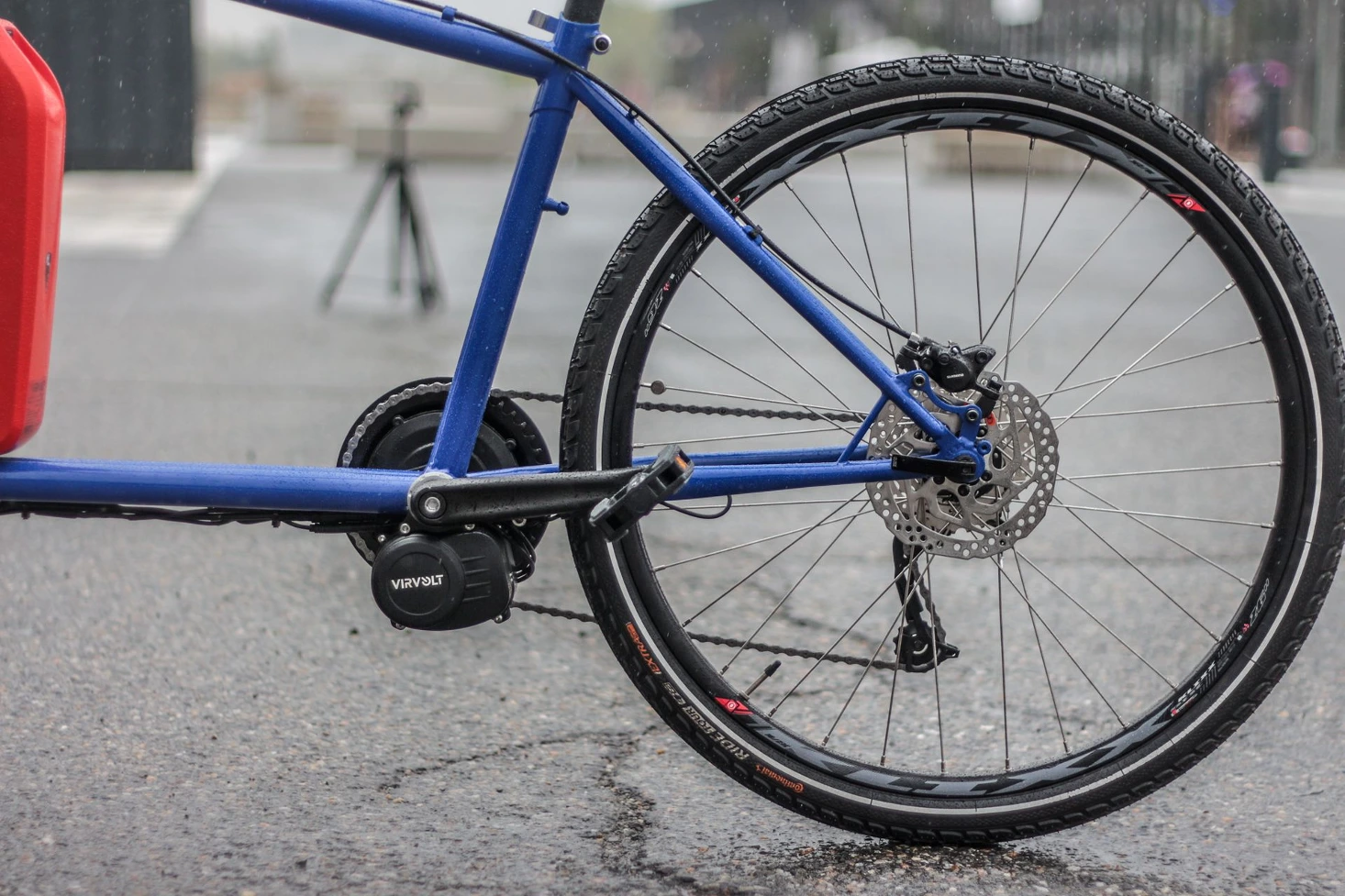
Another idea is to abandon the central motor to install a wheel motor, located in the front or rear hub.
This transformation is technically possible and is even common in projects converting traditional bikes to electric bikes.
A wheel motor has several advantages. It is generally simpler to install, often less expensive, and it operates independently of the bike's transmission. The rear motor, in particular, offers a good sense of propulsion.
However, switching from a central motor to a wheel motor completely changes the behaviour of the bike.
A central motor takes advantage of the bike's speeds and uses the transmission to optimise its efficiency. It is therefore particularly effective on steep climbs and difficult terrains.
A hub motor works directly on the wheel. It is often very pleasant in the city, on flat journeys and for daily commutes, but it may be less effective in certain situations such as steep slopes or sports uses.
This modification also involves reviewing several elements: motorised wheel, controller, battery, display, sensors and wiring.
The Save my eBike adapters: a new solution to replace an integrated central motor
Until recently, replacing a proprietary central motor was often complicated, if not impossible. Frames designed around a Bosch, Shimano or Yamaha motor greatly limited the possibilities for evolution.
A new approach involves using specific adapters allowing the installation of another type of motor in the existing frame.
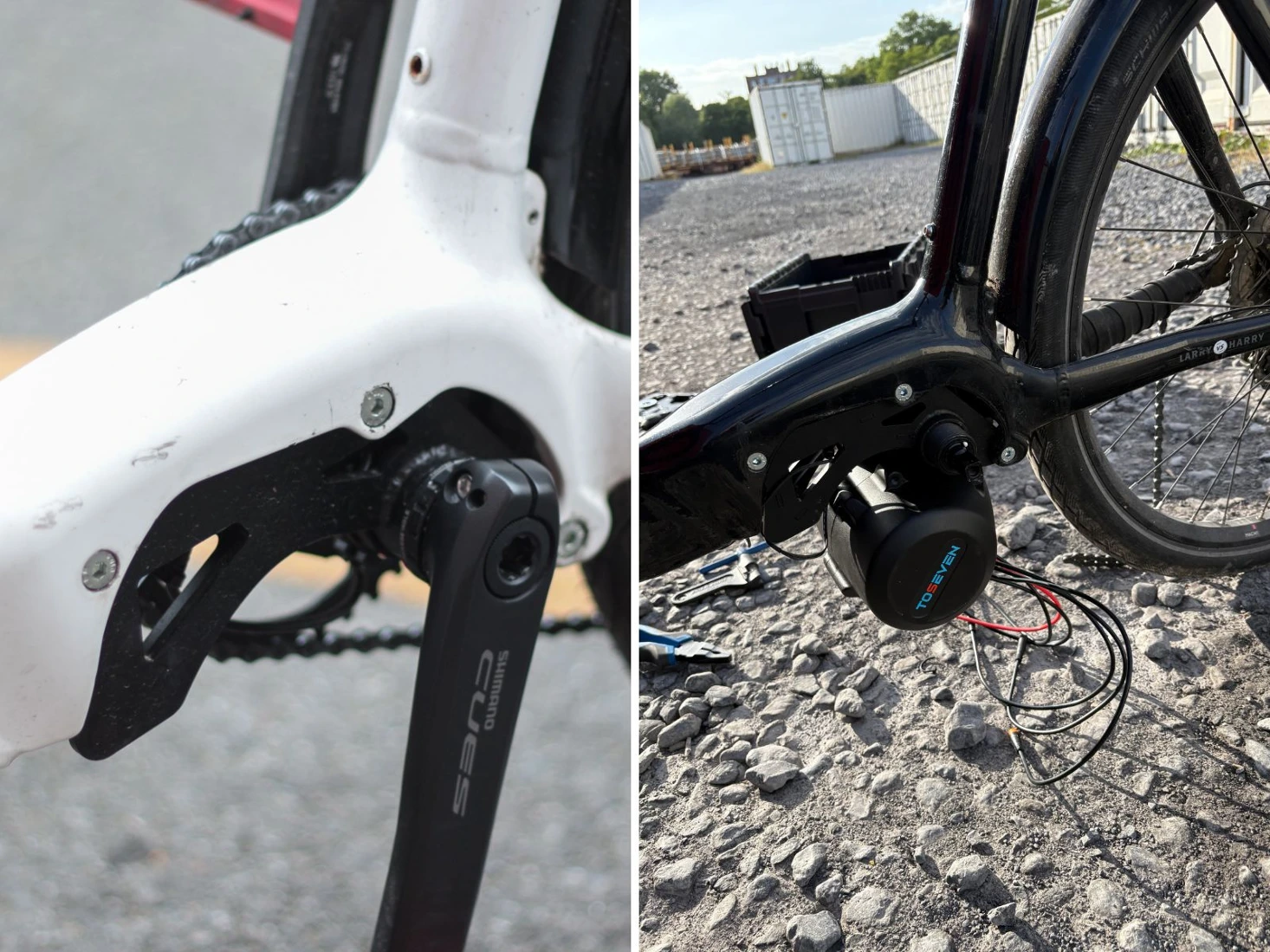
The proposed adapters by Save my eBike specifically address this issue: allowing the replacement of an original central motor with a central motor from an electrification kit or even with a hub motor solution.
The goal is to give a second life to electric bikes whose motor is difficult to repair or where replacement with an original part is too costly.
Thanks to this type of adaptation, a bike equipped with a proprietary central motor can potentially accommodate a more accessible, more powerful or easier to maintain motor.
This approach opens up new possibilities for the repair and reuse of electric bikes. Instead of completely replacing a bike whose frame and cycle parts are still in good condition, it becomes possible to modernise only the motorisation.
However, this solution requires a precise study of the bike: frame dimensions, motor location, battery compatibility, desired power, and intended use.
Should the motor be replaced or should one completely change the electric bike?
Changing the motor of an electric bike can be an excellent solution when the bike has a good mechanical base: solid frame, battery still in good condition, functional transmission, and quality components.
However, one must compare the total cost of the operation. A complete replacement with a proprietary system can quickly become expensive, especially on models equipped with Bosch, Shimano, or Yamaha motors.
In some cases, a conversion with a more open motor or the use of an adapter can be an economical and ecological alternative.
The right decision therefore depends on several factors: age of the bike, condition of the battery, price of parts, availability of the motor, and level of customisation sought.
Conclusion: yes, it is possible to install another motor on an electric bike, but one must choose the right solution.
Installing another motor on an electric bike is entirely possible, but the feasibility depends heavily on the type of current motor and the system used.
Replacing a Bosch with a Shimano, a Shimano E6100 with an EP6, a Bosch Gen 2 with a Gen 4, or a Bafang with a Tongsheng requires a compatibility analysis. In the majority of cases, the motor does not operate alone: it is part of a complete electronic system.
The proprietary confinement around the frame and the motor greatly restricts the possibility of making this type of change. It is possible to find similarities, such as between the Shimano EP8, 5000, 6100 motors, or within the same generation of Bosch motors (Bosch usually offers the same mounting system within a single generation: Gen 1, Gen 2..), or even between shared models (Yamaha PW-X and SyncDrive on the Giant), but the entire electronic part as well as the battery may need to be changed.In short, a real adventure, think carefully before diving in!
Replacing only the motor while keeping the battery is sometimes possible, but it depends on the technology used. Switching from a central motor to a wheel motor is also feasible, with consequences for the bike's behaviour.
Solutions like the adapters Save my eBike represent an interesting evolution, as they allow for the repair and transformation of electric bikes that were previously difficult to modify using non-proprietary and non-intrusive systems (such as wheel motors or electrification kits).
Before any intervention, the best approach is therefore to precisely identify the installed motor, the battery, the type of frame and the desired objective: to find a functional bike, to enhance performance or to modernise an old motorisation. With the right approach, replacing the motor of your electric bike can be a true second life rather than just a simple part replacement.