The range of an electric bike remains, before price or design, the criterion that weighs the heaviest at the time of purchase. Being able to connect your home to your office without fearing a breakdown, going for a hike of several hours in the mountains, or simply not having to recharge your battery every two days: this is what lies behind this seemingly simple question. However, between the figures announced by manufacturers and the kilometres actually travelled on the ground, the gap can be considerable. Understanding what really determines the distance travelled by an electric assistance bike (EAB) not only allows for better choice of your future bike but also helps to make the most of the one you already own.
What is the range of an electric bike and how is it calculated?
The range refers to the distance a cyclist can travel on a single battery charge, before the electric assistance stops due to lack of energy. This data directly depends on the energy capacity of the battery, expressed in watt-hours (WH), a unit obtained by multiplying the voltage expressed in volts by the capacity expressed in ampere-hours (ah). A battery rated at 36 volts and 14 ampere-hours thus has a capacity of approximately 504 watt-hours, a format now considered standard on the majority of city and trekking bikes sold in France.
To estimate a theoretical range, the formula remains relatively simple : it is enough to divide the battery capacity by the average consumption expressed in watt-hours per kilometre. In real use, an electric bike generally consumes between seven and twelve watt-hours per kilometre depending on the riding conditions. A five hundred watt-hour battery used at a rate of ten watt-hours per kilometre will therefore allow for a distance of approximately fifty kilometres. However, this calculation remains an approximation, as actual consumption varies greatly from one journey to another, from one cyclist to another, and even from one hour to another depending on the weather of the day.
The factors that actually influence the range of an e-bike
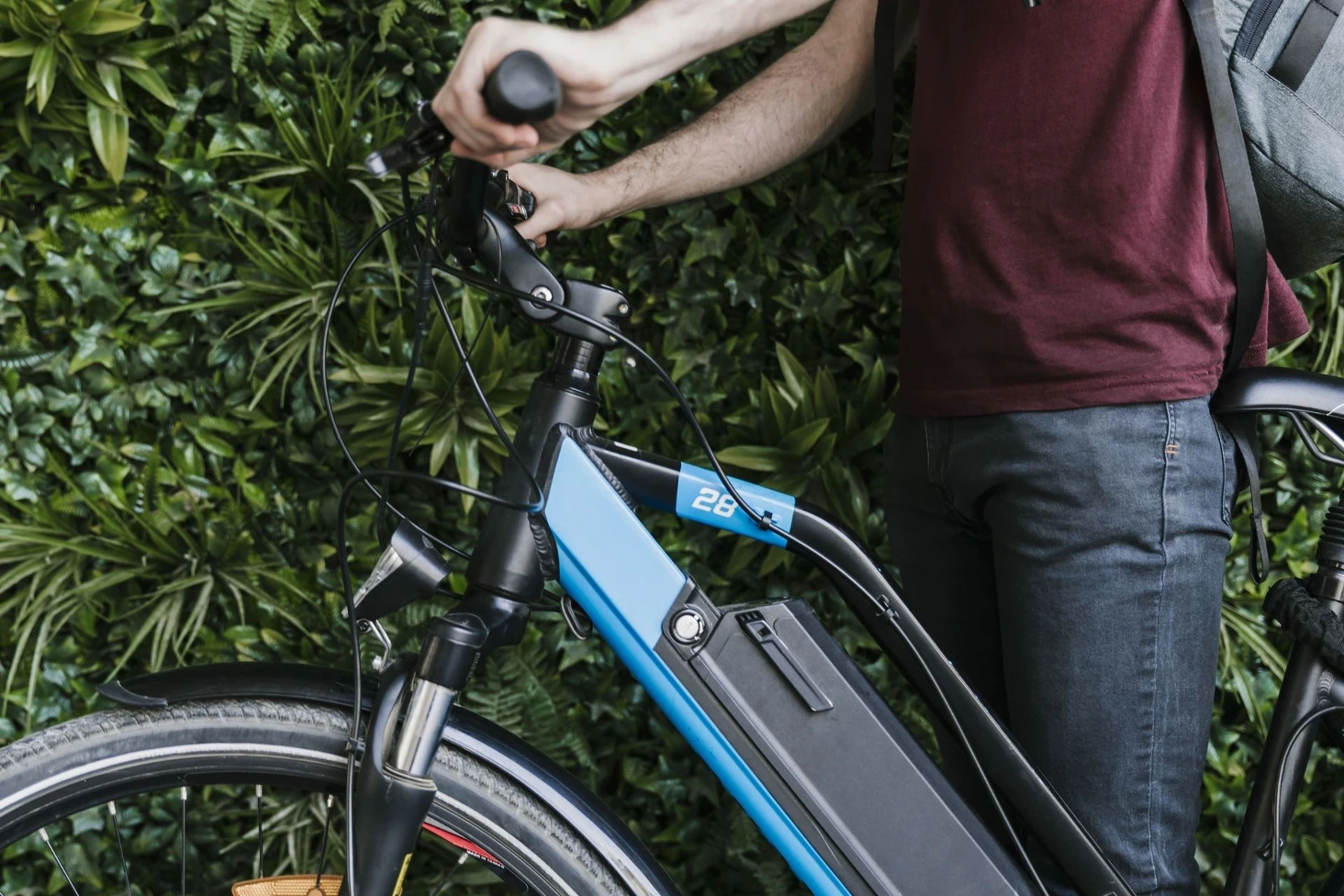
Contrary to what the technical specifications suggest, the range of an electric bike does not depend solely on the size of its battery. Several elements add up and can vary the distance travelled from simple to double with the same battery.
The chosen assistance mode plays a determining role. In eco mode, consumption generally ranges between ten and fifteen watt-hours per kilometre, while in sport or turbo mode, it can rise between twenty and fifty watt-hours per kilometre depending on the power of the motor used. Riding in maximum assistance for the entirety of a journey can thus halve or even reduce the available range by two or three times compared to a more measured use.
The total weight carried also counts a lot, as it adds that of the bike, the cyclist and any luggage or children seated on a seat. The heavier the load, the more effort the motor must provide to maintain the speed and assistance requested, which accelerates battery consumption. Similarly, the cumulative elevation on a route weighs heavily in the energy balance: an ascent puts intense demand on the motor, while a descent or flat terrain allows for the preservation of stored energy.
The outside temperature also directly influences the performance of lithium-ion batteries, a technology used by almost all current electric bikes. The cold slows down the internal chemical reactions of the battery and can reduce its effective capacity by ten to twenty percent during winter journeys, a phenomenon that many cyclists discover with surprise at the first cold snap. Conversely, excessive heat does not improve performance and can, in the long term, accelerate the aging of the cells.
Finally, more subtle parameters also come into play: insufficient tire pressure increases rolling resistance and thus consumption, a constant headwind imposes additional effort on the motor, and the type of motorisation chosen is not neutral either. The pedal motors, positioned at the bottom bracket, generally offer better energy efficiency than motors installed in the wheel hub, especially in the mountains where their ability to leverage the cyclist's torque makes a real difference.
What range to expect depending on usage
The range requirements vary greatly depending on the type of journey planned, and it would be a shame to pay for an oversized battery capacity if one only rides a few kilometres a day. For a daily round trip between home and work over a reasonable distance, a battery of three hundred to four hundred watt-hours is more than sufficient, even if it means recharging every two or three days without it being a particular burden.
For more intensive urban use or leisure outings at the weekend, the range of four hundred to six hundred watt-hours is currently the most common compromise on the market, typically offering between sixty and one hundred kilometres of range depending on the terrain and the mode of assistance used. Cyclists who are considering long distances, repeated hilly routes, or who practice electric mountain biking, on the other hand, turn to batteries of seven hundred to eight hundred watt-hours, or even to dual battery systems, capable of exceeding one hundred and fifty kilometres under favourable conditions. However, it is important to keep in mind that the same equipment, used at maximum assistance on demanding mountainous terrain, may sometimes not last more than thirty to forty kilometres, illustrating how much real usage takes precedence over the technical specifications.
Why the advertised range often differs from the actual range
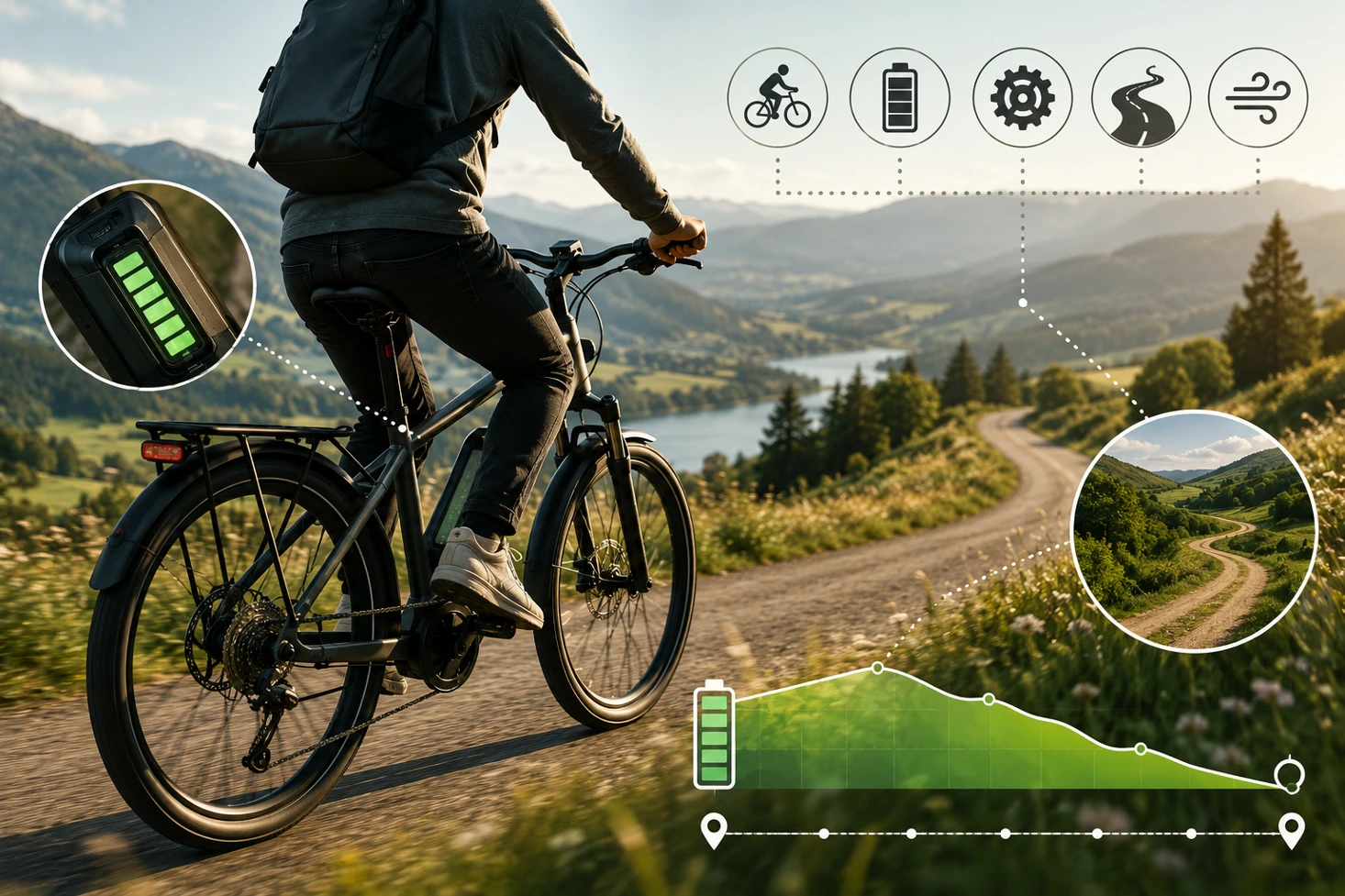
The distances highlighted by manufacturers are generally obtained under particularly favourable laboratory conditions: flat terrain, ideal temperature, light cyclist, and assistance set to the most economical level. On the road, reality often proves to be quite different, and the gap between the marketing figure and the actual mileage observed can reach thirty to forty percent. Two cyclists equipped with identical bikes and batteries of the same capacity can thus achieve very different results on the same day, simply because one pedals actively while supporting the assistance, while the other relies almost entirely on the motor. This variability explains why it is wiser, when choosing an electric bike, to think in lower ranges rather than relying solely on the most optimistic figure displayed on the label.
How to extend the range of your electric bike on a daily basis
Several simple habits allow you to gain miles without changing the battery. Adjust the level of assistance to the terrain rather than riding systematically in maximum mode is the most effective lever, particularly on flat sections where moderate assistance is more than sufficient to maintain a good speed. Maintain adequate tyre pressure significantly reduces rolling resistance and therefore the demand on the motor, just like regular maintenance of the chain and transmission, whose excessive friction can quietly eat away at precious watt-hours over the miles. Anticipate the terrain adjusting the assistance before a climb rather than reacting once the slope has started also helps to optimise the management of the available energy on a given journey.
Driving behaviour is finally just as important as the technical settings : gradual accelerations put much less strain on the battery than repeated sudden starts at every traffic light or intersection, a detail that, when accumulated over an urban journey with many stops, can represent a significant portion of the total consumption.
Maintaining your battery to preserve its autonomy over time
Beyond daily use, the longevity of the battery itself determines the available autonomy in the long term. A lithium-ion battery typically supports between five hundred and a thousand full charge cycles before its capacity begins to decline significantly, which represents several years of use for a regular cyclist. To best preserve its performance, it is recommended to store it at room temperature rather than in an unheated garage in winter, to avoid letting it discharge completely repeatedly, and not to expose it unnecessarily to excessive heat in direct sunlight. These simple precautions, often overlooked, explain why two batteries of the same capacity and age can show very different autonomies depending on how they have been treated over the months.
Frequently asked questions about the autonomy of electric bikes
What battery capacity should I choose to ride one hundred kilometres without recharging? Generally, one should count on a battery of at least six hundred to seven hundred watt-hours, taking into account a safety margin of about twenty percent relative to the intended distance, as the terrain and the mode of assistance used will cause actual consumption to vary both upwards and downwards.
Does the cold really reduce range in winter? Yes, low temperatures slow down the internal chemistry of lithium batteries and can reduce effective capacity by ten to twenty percent, a reversible phenomenon that disappears with the return of milder conditions.
Can one improve the range of an already purchased electric bike without changing the battery? To a large extent, yes: adjusting the mode of assistance according to the terrain, regular maintenance of the mechanics, and correct tyre pressure are often enough to recover several kilometres per trip, without any additional investment.
In summary
The range of an electric bike is never just a simple number listed on a product sheet. It results from a combination of technical factors, such as battery capacity and motor type, and usage-related factors, such as the terrain covered, the weight carried, the outside temperature, and the chosen mode of assistance. Understanding these mechanisms well allows one to select a bike that is truly suited to their usual journeys, rather than being guided solely by the most impressive mileage displayed in the shop window, and to adopt the right habits daily to preserve, trip after trip, the full potential of their battery.